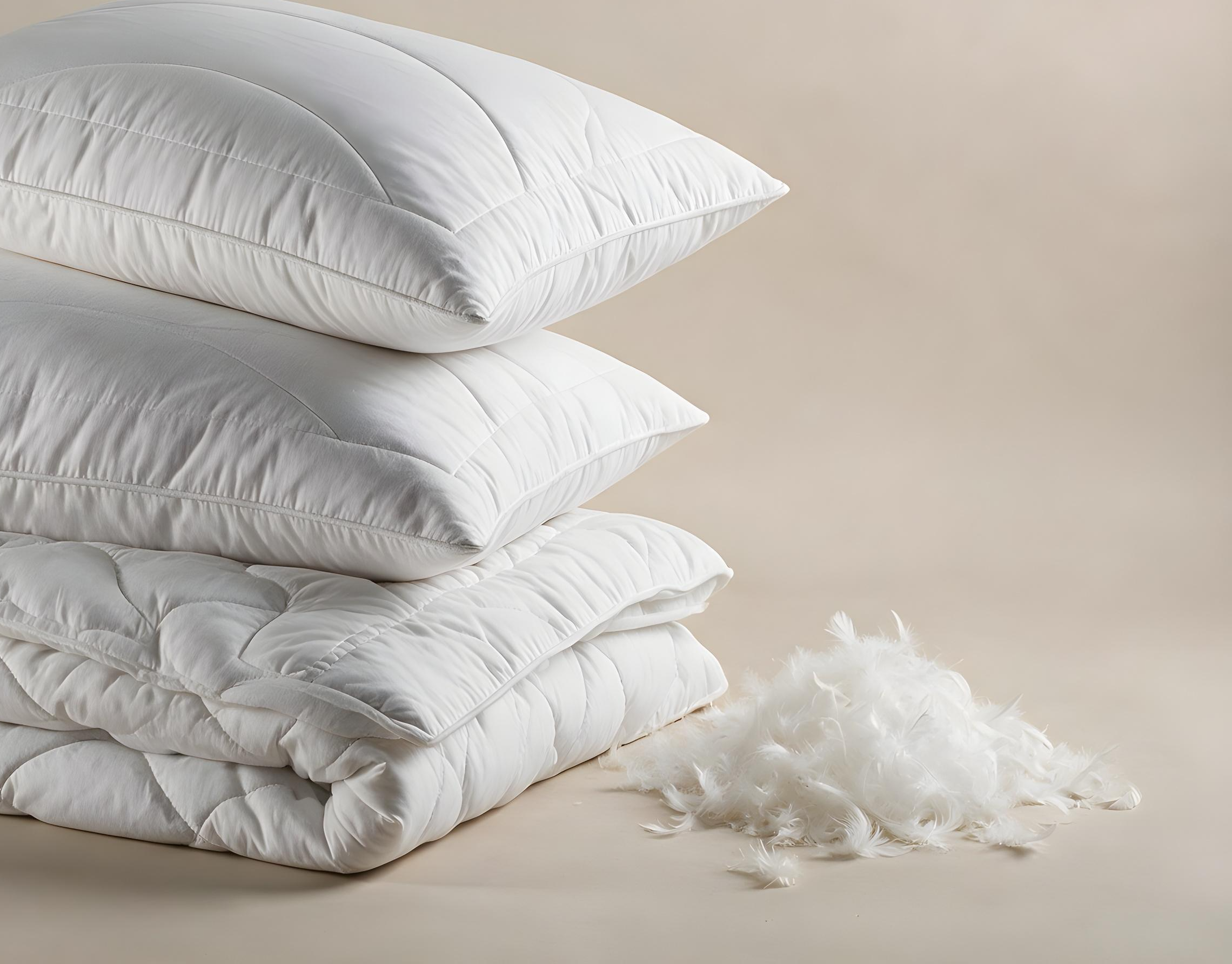
A down duvet or feather pillow does not have to be thrown away once it loses its loft. The natural filling can be professionally cleaned and sealed into a new casing. This is called down and feather renovation. In this guide we explain how it works step by step, how to tell that your duvet needs it, and when buying a new one makes more sense. It is based on the experience of AMW Nawrot’s own feather laundry and sorting plant in Pyrzowice, Poland.
In short
- Renovation means professionally washing, drying and dedusting natural filling (down and feathers) and putting it into a new casing.
- Consider it when the duvet loses loft, has lumps or thin spots, smells unpleasant, or when filling escapes through worn fabric.
- Renovation applies to down and feathers. Synthetic duvets are washed according to the care label or replaced.
- At AMW we wash the filling with specialist detergents, dry it at around 110°C, dedust it during drying and fill it into a new casing.
What is down and feather renovation?
Renovation refreshes the natural filling of a duvet or pillow. Down and feathers are durable, but over time they collect dust, sweat and skin flakes, and the casing fabric wears out. Instead of throwing the whole duvet away, the filling is taken out, washed, dried, dedusted and sealed into a new, tightly woven casing.
How renovation works step by step – the AMW example
This is the process we run in our feather laundry and sorting plant in Pyrzowice. We have worked with feathers for generations: we opened our own laundry and sorting plant in 1981, and in 1990 a new laundry with a paddle washer and a jacketed dryer. Today we process around 4 tonnes of feathers and down every day.
- Assessment. We check what the filling is and what condition it is in.
- Removing the filling. The old casing is opened and the down and feathers go on for processing.
- Washing. The filling is washed with specialist detergents designed for feathers.
- Drying and dedusting. We dry it at around 110°C. During drying the material is dedusted, removing dust and fine particles.
- New casing. The clean, dry filling is put into a new casing.
After renovation the filling is clean, dry and lofty again.
How to tell your duvet needs renovation
- the filling forms lumps that do not disappear when you shake it,
- thin spots appear and the duvet warms unevenly,
- the duvet is noticeably less lofty and less warm than at first,
- there is a musty or damp smell that does not go away after airing,
- feathers poke through the fabric, or the casing is worn or stained,
- the duvet once got very damp and was not dried thoroughly.
If you recognise two or three of these signs, renovation will usually bring back the comfort. Before that, check our tips on everyday duvet care – some issues, such as light lumps, can be solved by daily shaking and airing.
How long does a down duvet last?
Lifespan depends on the filling, use and care. Industry estimates put a feather duvet at about 5–8 years and a down-and-feather duvet at about 7–10 years. A higher share of down usually means more resilience and longer-lasting loft. Renovation extends this time, because the filling is refreshed and a new casing replaces the worn fabric.
When is renovation not worth it?
- Synthetic fillings (e.g. polyester fibre, silicone fibre balls or Amball): renovation in this sense applies to down and feathers. A synthetic duvet is washed according to the care label and replaced once it loses its resilience.
- Very damaged filling that has largely turned to dust. After dedusting there might not be enough left for the duvet to stay warm.
- When you need a different duvet – another warmth class, size, or one for an allergy sufferer who should avoid natural fillings. Then a new product is the better choice.
Renovation or washing at home?
| Washing at home | Professional renovation | |
|---|---|---|
| What happens to the filling | stays in the old casing | is taken out, washed, dried and dedusted |
| Drying | hard to dry fully; damp down clumps | drying at around 110°C with dedusting |
| Casing (fabric) | the same, increasingly worn | new |
| Suitable for | only if the care label and drum size allow | duvets and pillows with down and feathers |
Washing at home works well for smaller duvets and pillows when the care label allows it. A large down duvet that cannot be dried thoroughly at home is better taken to a professional feather laundry.
How to care for a duvet after renovation
- shake your duvet and pillow every morning so the filling spreads evenly,
- air the bedroom and air the duvet on a dry day now and then,
- always use a duvet cover and pillowcase and change them every 1–2 weeks,
- store the duvet only when dry, in a breathable bag, without tight compression.
For more tips, including how to stop the filling from clumping, see our guide Duvet and pillow care.
Renovation or a new duvet?
If the filling is in good condition and the issue is mainly dirt, smell or a worn casing, choose renovation – you keep valuable down and give the duvet a second life. If you need a different duvet, choose a new one.
See AMW down duvets, down pillows and feather pillows in our online shop (in Polish).
Frequently asked questions about renovation
Can a feather pillow be renovated?
Yes. Both duvets and pillows with natural down and feather filling can be renovated.
Can I choose a different size than my current duvet or pillow?
Yes. When you renovate, you can choose a different size than your current duvet or pillow.
Does renovation remove dust mites?
Washing with specialist detergents and drying at around 110°C removes dust mites, microbes and dust that have built up in the filling.
Will my duvet be as good as new after renovation?
The filling will be clean and lofty, and the casing new. The filling keeps its age, though: with very worn down some broken feathers fall away during dedusting, so the duvet may be slightly lighter. Ask us whether topping up the filling is possible in your case.
How do I send a duvet for renovation to AMW?
Write to us using the form on our website or give us a call. We will agree the details and assess whether renovation makes sense in your case.
About the author: AMW Nawrot
This guide was prepared by the team at AMW Nawrot sp.k., a family manufacturer of duvets, pillows and mattresses from Pyrzowice, Silesia, Poland, with a tradition in feather processing dating back to 1915. We run our own feather laundry and sorting plant, sew in our plants in Pyrzowice and Czeladź, and our products are RDS, OEKO-TEX® and GOTS certified. Have a question about renovation? Contact us or visit the AMW shop.