
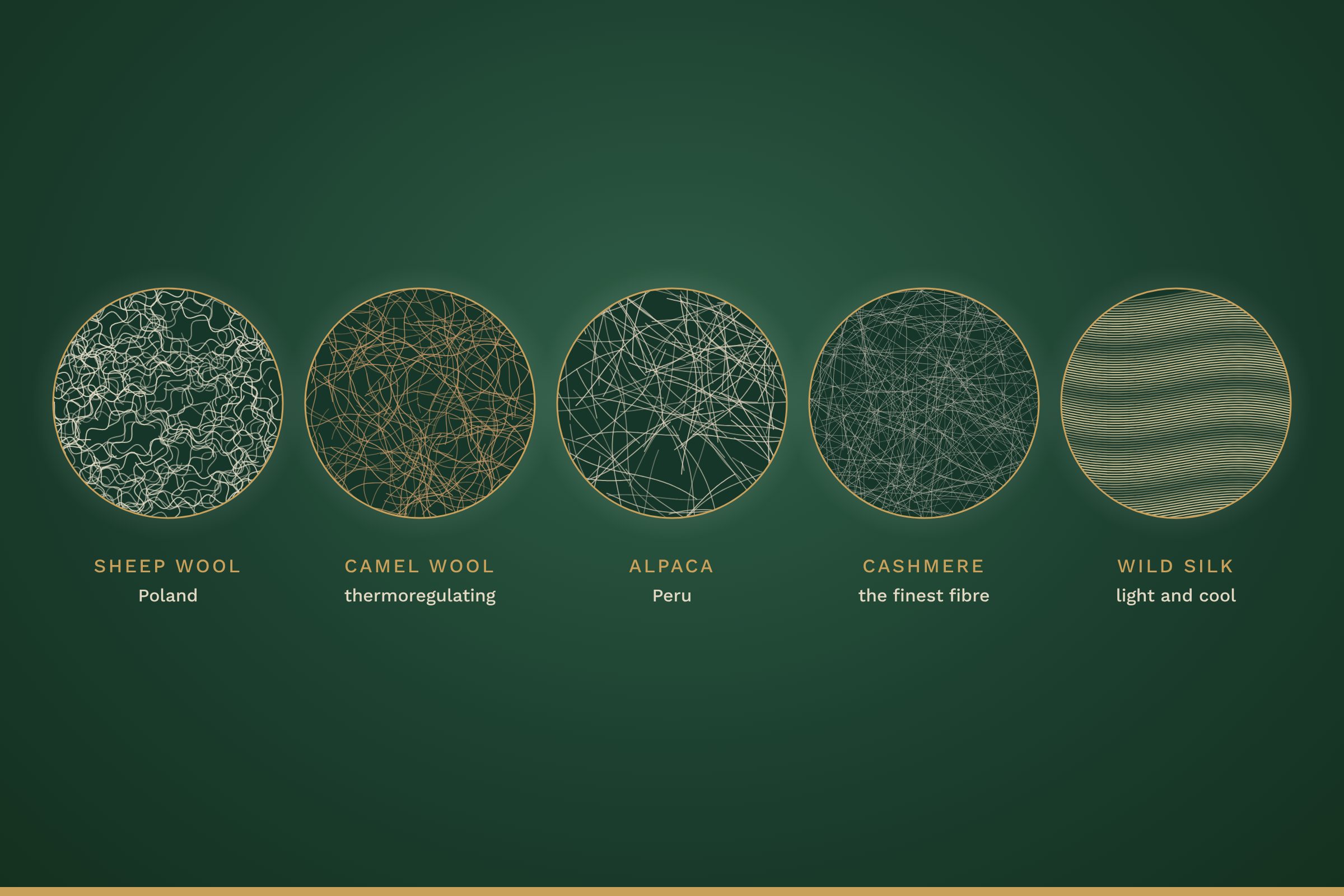
People choose duvets made from animal fibres to sleep at a steady temperature – without overheating or sweating. Sheep wool, camel wool, alpaca, cashmere and wild silk, however, each behave differently. We compare them and explain how to read the composition on the label and how to care for such a duvet.
Key differences
| Sheep wool | Camel wool | Alpaca | Cashmere | Wild silk | |
|---|---|---|---|---|---|
| Warmth | high | high | high for its weight | very high for its weight | low |
| Moisture | absorbs a lot | regulates very well | wicks well | wicks well | wicks very well |
| Feel | springy | soft | very soft | the finest | smooth, draping |
| Season | all year, winter | all year | all year, winter | winter | summer |
| Price | lowest | medium | higher | highest | high |
What about loft? Wool and silk duvets are flatter than down duvets – they do not form a “cloud” over the sleeper, but they drape well over the body. For many people that is an advantage: not everyone wants a fluffy duvet, and some prefer a thinner one that lies close and warms evenly.
Sheep wool
The most popular and most affordable of the wools. The sheep wool AMW Nawrot uses in its duvets comes from Poland. It absorbs a lot of moisture before it starts to feel damp, so it stays dry under the duvet. It helps keep body temperature steady, and its properties are also valued in rehabilitation.
Camel wool
The soft undercoat of the camel, lighter than sheep wool. It is known for its thermoregulating properties – it keeps out the cold in winter and the heat in summer.
Alpaca
Fibre from alpaca fleece – the alpaca in AMW Nawrot duvets comes from Peru. It is very soft and contains little lanolin, so it lacks the typical smell of sheep wool. Its partly hollow fibres give a lot of warmth for little weight.
Cashmere
The fine undercoat of the cashmere goat, with very thin fibres – usually under 19 micrometres. Cashmere duvets are fluffy and insulate very well. It is the most expensive of the wools, so it is often blended with wool – then its percentage matters.
Wild silk
Obtained from the cocoons of Asian moths. The duvet is thin, light and draping, wicks moisture superbly and gives little warmth – it works best in summer and for people who overheat easily.
For winter
Cashmere, alpaca or a heavier sheep wool duvet.
All year
Camel wool, alpaca or sheep wool.
For summer
Wild silk or a light wool duvet.
Best price
Sheep wool.
For business: We make duvets and pillows under our brand and under our clients’ brands (private label and white label) – at our own plants in Poland. Request a quote →
How to read the label
- The label lists the composition of the filling and of the cover fabric separately.
- The filling is given as fibre percentages (EU Regulation 1007/2011), e.g. “70% sheep wool, 30% cashmere”.
- The name “cashmere” may only be used for the fibre of the cashmere goat, and “silk” only for fibre from silkworm cocoons. Fibres that merely feel similar may not be called that.
- The weight (g/m²) matters too – the higher it is, the warmer the duvet. At the same weight, cashmere and alpaca are warmer than sheep wool.
For a comparison of wool with down, feathers and synthetic fibres, see our guide Down, feathers or fibre?
Frequently asked questions
Can a wool duvet be washed at home?
It depends on the care label. Wool does not like high temperatures or friction – it can felt and shrink, and if not dried thoroughly it can clump or smell unpleasant. In everyday use, regular airing in the shade is enough; wash only as the label allows. More about washing and drying in our care guide.
Can a silk duvet be washed?
Usually not – airing it and protecting it with a duvet cover is enough. Always check the care label.
Does wool itch?
No – the filling is enclosed in the cover fabric, usually cotton, so it does not touch the skin.
For business
Wool, alpaca, cashmere and silk duvets – under our brand and yours
We make duvets and pillows with sheep wool, camel wool, alpaca, cashmere and wild silk under our own brand and under yours. We match the composition and weight to your collection – also using customer-supplied materials.